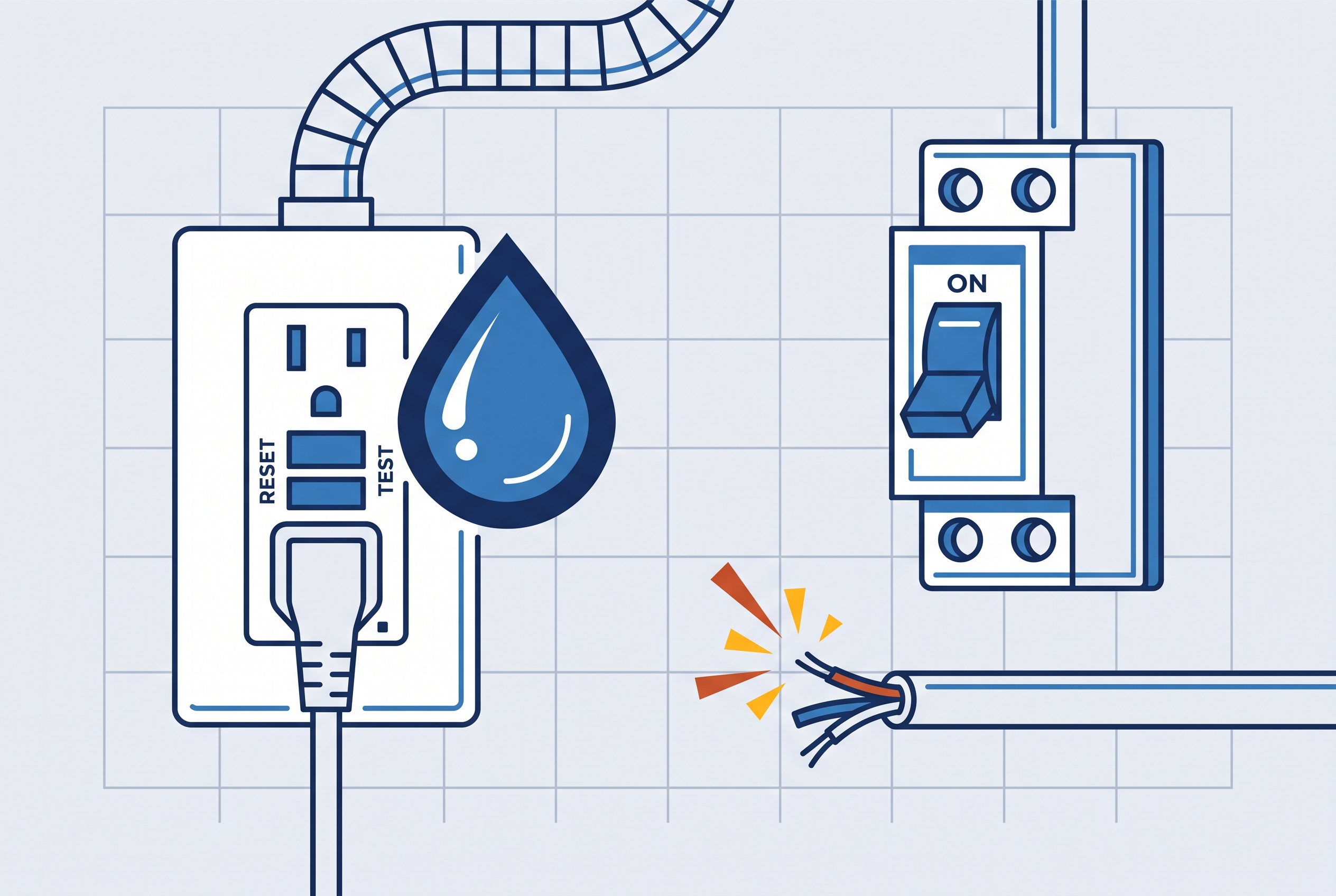
A GFCI (ground fault circuit interrupter) protects people from electric shock by cutting power when current leaks to ground, for example through water or a person. An AFCI (arc fault circuit interrupter) protects the house from fire by cutting power when it detects dangerous arcing from damaged, overheated or loose wiring. They guard against different hazards, so they’re not interchangeable, and many circuits benefit from both. Combination “dual-function” devices provide both on one circuit.
Neither replaces a standard breaker’s overload protection; they add to it.

How a GFCI works
In a normal circuit, the current flowing out on the hot wire equals the current returning on the neutral. A GFCI constantly compares the two. If some current is escaping another way, such as through a person touching a faulty appliance, the two no longer match. The U.S. Consumer Product Safety Commission says a GFCI cuts power when the difference is as little as 0.006 amps, “faster than a blink of an eye.” ESFI credits GFCIs with saving thousands of lives since the 1970s.
GFCIs come as outlets with TEST and RESET buttons, as breakers in the panel, and as portable plug-in units for outdoor tools.
How an AFCI works
An arc is electricity jumping a gap, such as across a frayed cord, a nail through a cable or a loose connection. Arcs can be hot enough to ignite nearby materials but may not draw enough current to trip a standard breaker. An AFCI monitors the circuit’s electrical signature for the patterns of dangerous arcing and shuts it off. ESFI cites a CPSC estimate that AFCIs could prevent more than half of the electrical fires that occur each year. AFCIs are usually breakers with a TEST button; AFCI outlets also exist.
Where each is required
Requirements come from the National Electrical Code as adopted by your state or city, and they’ve expanded over the years, so older homes may have less protection than new ones.
- GFCI: the CPSC lists outdoor, bathroom, garage, kitchen, crawl space, unfinished basement, wet bar and laundry or utility sink locations, among others.
- AFCI: required for many living-area circuits, such as bedrooms and living rooms, in new homes. ESFI notes the code has required expanded AFCI protection since the 2008 edition, subject to local adoption.
Kitchens and laundry areas in newer homes often need both types of protection.
Side by side
| GFCI | AFCI | |
|---|---|---|
| Protects against | Electric shock | Electrical fires |
| Detects | Current leaking to ground | Dangerous arcing |
| Typical form | Outlet or breaker | Breaker (outlets exist) |
| Typical locations | Wet and outdoor areas | Living areas and bedrooms |
| Testing | At least monthly (CPSC) | As the manufacturer directs |
When they trip
A GFCI trip often points to moisture or a faulty appliance. An AFCI trip can point to damaged cords or loose wiring, though some older AFCIs also reacted to certain motors and electronics. Either way, repeated trips deserve attention rather than repeated resets. See GFCI outlet won’t reset and why a breaker keeps tripping.
What you can do yourself vs. when to call a pro
| Safe for most homeowners | Call a licensed electrician |
|---|---|
| Test GFCIs monthly and AFCIs per the label | Adding AFCI or GFCI breakers to the panel |
| Use portable GFCIs for outdoor tools | Repeated AFCI trips |
| Replace frayed cords instead of repairing them | Updating protection in an older home |
Safety first. Breaker work happens inside a live panel and is a job for a licensed electrician. Never disable or bypass a GFCI or AFCI because it trips; the trip is often the warning. Keep working smoke alarms on every level of your home.
Frequently asked questions
Does a GFCI protect against fires?
Not specifically. It’s designed to prevent shock. Arc-related fire protection is the AFCI’s job, and overload protection is the standard breaker’s.
Can one device do both?
Yes. Dual-function AFCI/GFCI breakers and outlets combine both protections, which is useful where codes require both.
Do I need to upgrade an older home?
Codes generally apply to new work, not existing wiring. But adding GFCI protection in wet areas is inexpensive and worthwhile, and an electrician can advise on AFCI upgrades.
Sources
- U.S. Consumer Product Safety Commission, GFCI Fact Sheet
- Electrical Safety Foundation International, Ground Fault Circuit Interrupters
- Electrical Safety Foundation International, Arc Fault Circuit Interrupters