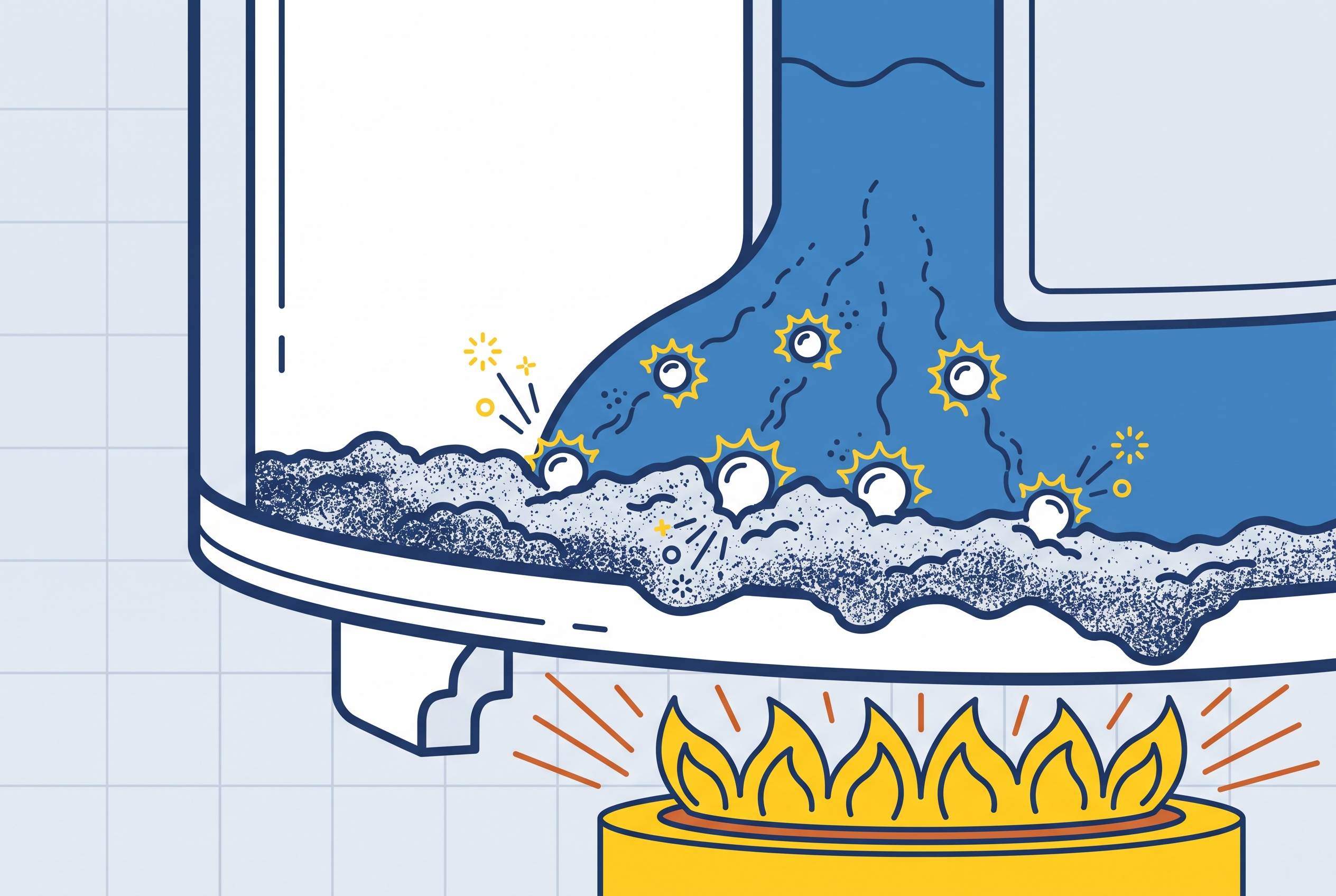
A water heater that pops, rumbles or crackles almost always has sediment on the bottom of the tank. Minerals from your water settle into a crusty layer, small pockets of water get trapped underneath it, and when the burner or lower element heats them, they flash into steam and burst through. That burst is the pop.
It isn’t an emergency, but it is a sign the heater needs attention. Sediment makes the heater work harder, wastes energy and, over time, stresses the bottom of the tank.

Where the sediment comes from
Most tap water carries dissolved minerals, mainly calcium and magnesium. Heating water makes some of those minerals come out of solution, and they sink to the bottom of the tank. The harder your water, the faster the layer builds. Bits of a deteriorating dip tube or anode rod can add to it too.
What the noise tells you
| Sound | Most likely cause |
|---|---|
| Popping or rumbling while heating (gas) | Sediment on the tank bottom |
| Crackling or hissing (electric) | Scale built up on the lower heating element |
| Sizzling, mostly on startup (gas) | Condensation dripping onto the burner, often normal |
| Ticking in the pipes | Pipes expanding and contracting as hot water flows |
| Screeching or whistling | A partly closed valve or high water pressure |
How to quiet it: flush the tank
Flushing removes loose sediment and often reduces or stops the noise. Always follow the steps in your owner’s manual, which may differ for your model. The general process:
- Turn the heater off: set a gas model to “pilot” or “off,” or switch off the breaker for an electric model. Never run an electric heater with the tank empty.
- Let the water cool for a few hours if you can. Tank water can scald.
- Close the cold water supply valve on top of the tank.
- Attach a garden hose to the drain valve and run it to a floor drain or outside.
- Open a hot water tap somewhere in the house to let air in, then open the drain valve.
- When the tank is nearly empty, briefly open the cold supply to stir up the remaining sediment, and repeat until the water runs clear.
- Close the drain valve, open the cold supply, and let the tank fill until water flows steadily from the open hot tap.
- Only then turn the heat back on.
If sediment has hardened into a thick crust, a flush may not remove it all, and the noise can continue. Drain valves on older heaters can also clog or start leaking once they’re opened. If that happens, see our guide to a water heater leaking from the bottom.
Is a popping water heater dangerous?
Popping on its own is a maintenance problem, not a safety emergency. It becomes a concern when it comes with other signs: water leaking from the tank, the T&P relief valve releasing water, or water that’s much hotter than the thermostat setting. In those cases, turn the heater off and call a plumber.
How to keep it from coming back
- Flush regularly. Once a year is a common routine; more often with hard water. Your owner’s manual will say what your manufacturer recommends.
- Keep the temperature moderate. Around 120°F, the setting the U.S. Consumer Product Safety Commission recommends for scald safety, also slows mineral buildup compared with higher settings.
- Consider a water softener if your water is very hard and scale is a problem throughout the house.
For a closer look at the parts mentioned here, see how a water heater works.
Frequently asked questions
Does a popping noise mean my water heater is about to fail?
Not by itself. Plenty of heaters pop for years. But heavy sediment on an older heater is a sign of wear, so if yours is near the end of its typical lifespan, start planning for a replacement.
Why does my electric water heater crackle?
Electric heaters don’t have a burner, so the noise usually comes from scale on the lower heating element. Flushing helps; a heavily scaled element can also be cleaned or replaced, with the power off.
Can I just ignore the noise?
You can, but the sediment keeps building, the heater works harder to heat the same water, and your energy bill reflects it. A flush is usually a free fix.
Sources
- U.S. Consumer Product Safety Commission, Tap Water Scalds