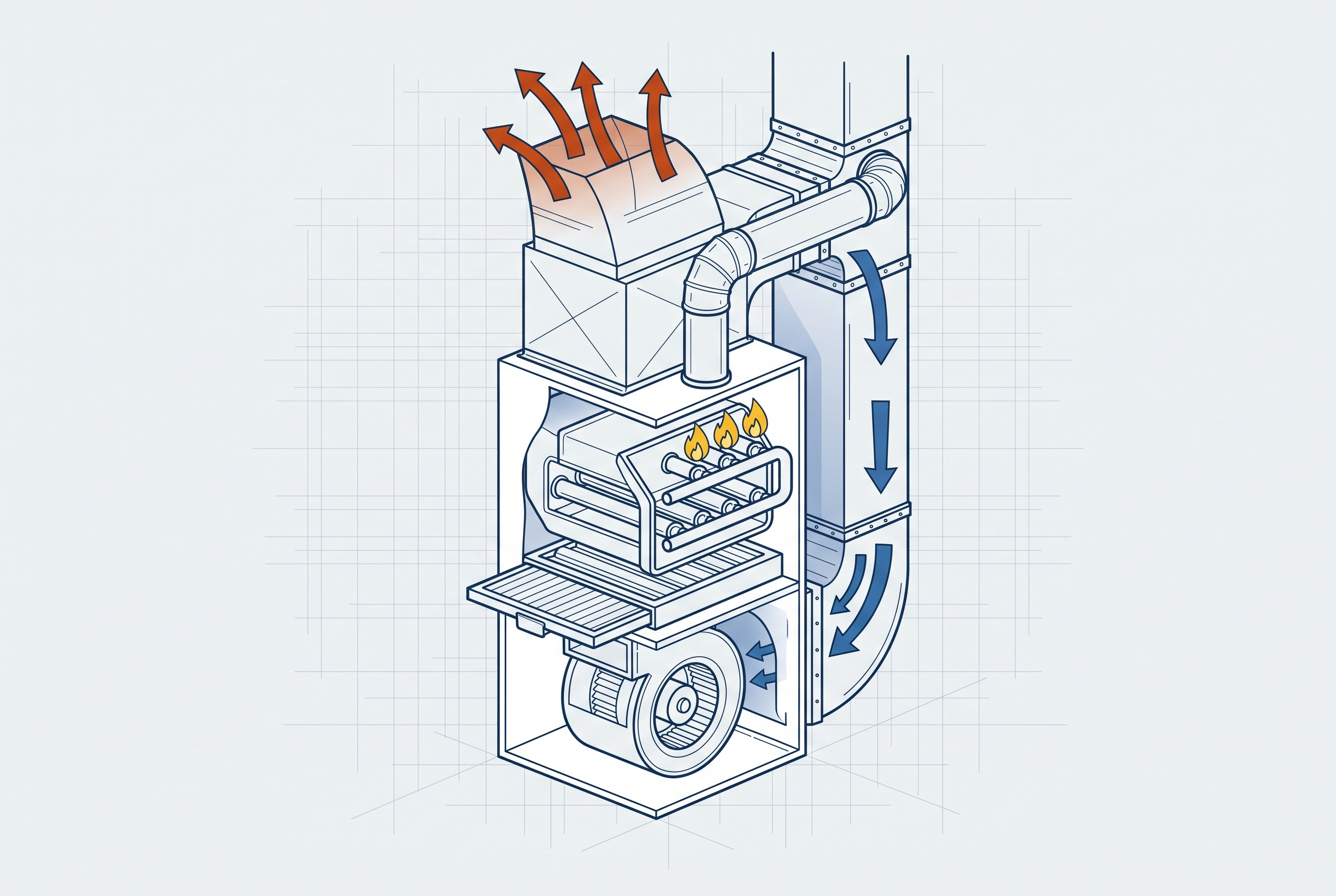
A gas furnace heats your home by burning gas inside a sealed metal heat exchanger, then blowing house air across the outside of it. The air picks up heat without ever touching the flame or the exhaust, travels through the ducts to your rooms, and returns to the furnace to be heated again. The exhaust leaves the house through a separate flue.
Modern furnaces wrap that simple idea in a sequence of safety checks. Understanding the sequence is the key to figuring out why a furnace won’t start, shuts off early or blows cold air.

The heating cycle, step by step
- The thermostat calls for heat when the room drops below your setting.
- The inducer motor starts and pulls air through the heat exchanger and out the flue, clearing out any leftover gases.
- A pressure switch confirms the inducer is moving air. If the vent is blocked, the sequence stops here.
- The igniter heats up. Most modern furnaces use a hot surface igniter that glows orange; some use a spark or an intermittent pilot.
- The gas valve opens and the burners light.
- The flame sensor proves the flame. If it doesn’t detect flame within a few seconds, the control board closes the gas valve.
- The heat exchanger warms up, and after a short delay the blower starts so it doesn’t push cold air into the house.
- Warm air flows to the rooms until the thermostat is satisfied.
- The burners shut off, and the blower keeps running briefly to pull the remaining heat out of the exchanger.
What each part does
| Part | Job | Common symptom when it fails |
|---|---|---|
| Air filter | Cleans return air before it reaches the blower | Weak airflow, overheating, short cycling |
| Blower | Moves air across the heat exchanger and through the ducts | Burners run but little or no air comes out |
| Inducer motor | Pulls combustion gases out through the flue | Humming or rattling, furnace won’t light |
| Pressure switch | Confirms the venting is clear | Furnace tries to start, then stops before lighting |
| Igniter | Lights the gas | No glow or spark, so the burners never light |
| Gas valve | Lets gas flow to the burners | No flame even with a working igniter |
| Flame sensor | Confirms the burners are lit | Burners light, then shut off after a few seconds |
| Heat exchanger | Transfers heat to the air while keeping exhaust separate | Cracks are serious: a carbon monoxide risk |
| High-limit switch | Shuts the burners off if the furnace overheats | Furnace runs briefly, then shuts off (see short cycling) |
| Control board | Runs the sequence and reports error codes | Blinking light code, erratic behavior |
Standard vs. condensing furnaces
Furnace efficiency is measured as AFUE, the share of the fuel’s energy that ends up as heat in your home over a season. A standard furnace has one heat exchanger and vents hot exhaust through a metal flue; the least efficient models sold today are around 80% AFUE.
A condensing furnace adds a second heat exchanger that pulls so much heat out of the exhaust that water vapor in it condenses. That’s why condensing furnaces have a drain line and usually vent through plastic pipe. According to the U.S. Department of Energy, condensing furnaces reach 90% to 98% AFUE, and ENERGY STAR-certified gas furnaces must hit at least 95% in northern states and 90% in southern states.
Carbon monoxide safety. Every home with a gas furnace should have working carbon monoxide alarms. If an alarm sounds, or you smell gas, leave the house and call 911 or your gas utility from outside.
Basic care that keeps a furnace running
- Check the filter monthly. ENERGY STAR recommends inspecting, cleaning or changing furnace filters once a month. A clogged filter is the most common cause of overheating and short cycling.
- Keep supply and return vents open and clear of furniture and rugs.
- Keep the area around the furnace clear, especially of anything flammable.
- Schedule a yearly checkup before heating season. A technician can clean the flame sensor and burners, check the heat exchanger and test the safety controls.
Frequently asked questions
Why does my furnace blow cold air for a minute when it starts?
It shouldn’t for long: the blower is designed to wait until the heat exchanger is warm. A short puff of cool air from ducts in unheated spaces is normal. Steady cold air while the furnace is running points to a problem with ignition, the flame sensor or a safety switch.
What does the blinking light on my furnace mean?
Most modern furnaces flash an error code from the control board. The code chart is usually printed on the inside of the furnace door and tells you which part of the sequence failed.
Can I clean the flame sensor myself?
Many homeowners do, with the power and gas off, by gently cleaning the metal rod. If you’re not comfortable working inside the burner compartment, leave it to a technician during the yearly service.
Sources
- U.S. Department of Energy, HVAC Direct Vent Equipment
- U.S. Department of Energy (FEMP), Purchasing Energy-Efficient Residential Furnaces
- ENERGY STAR, Maintenance Checklist