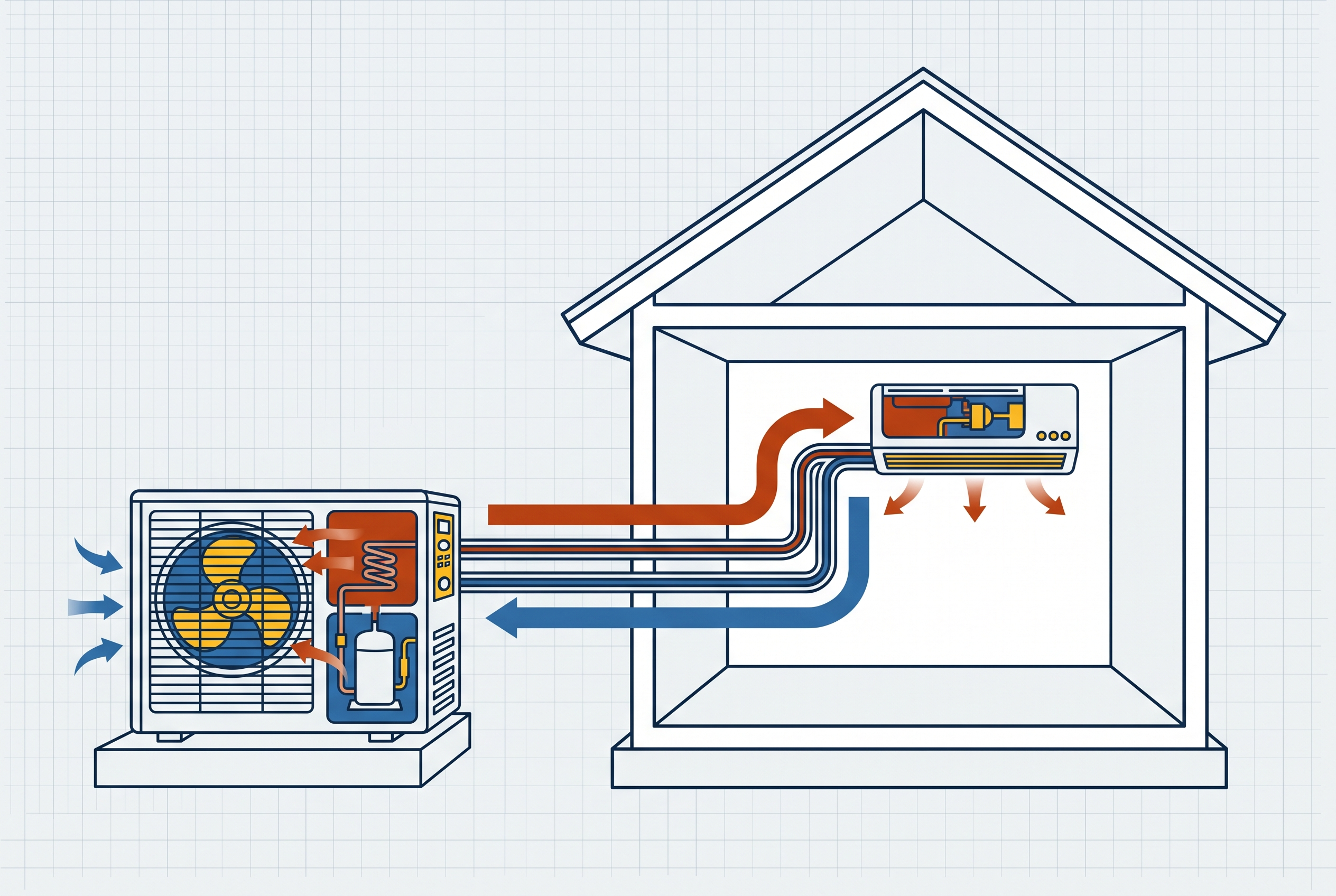
A heat pump doesn’t burn fuel to make heat. It moves heat that already exists. In winter it pulls heat out of the outdoor air, even cold air, and releases it inside. In summer a valve reverses the flow and it works like an air conditioner, pulling heat out of your house and dumping it outside. Because moving heat takes less energy than creating it, a heat pump can deliver up to three times more heat energy than the electricity it uses.
Most homes with a heat pump have two pieces: an outdoor unit with a fan, a coil and a compressor, and an indoor air handler with a second coil and a blower. Copper lines carrying refrigerant connect them.

The refrigerant cycle, step by step
Everything a heat pump does relies on one fact: a refrigerant absorbs heat when it evaporates and gives heat off when it condenses. The system keeps the refrigerant moving in a loop so that it evaporates in one coil and condenses in the other.
- Absorb. Cold, low-pressure liquid refrigerant flows through the outdoor coil. It is colder than the outdoor air, so it soaks up heat from that air and evaporates into a gas.
- Compress. The compressor squeezes that gas. Raising its pressure also raises its temperature, so the refrigerant leaves the compressor much hotter than it went in.
- Release. The hot gas flows to the indoor coil. The blower pushes house air across the coil, the air picks up the heat, and the refrigerant cools and condenses back into a liquid.
- Expand. The liquid passes through an expansion device that drops its pressure and temperature, and it heads back outside to start again.
How it switches between heating and cooling
The part that makes a heat pump different from a plain air conditioner is the reversing valve. When you set the thermostat to cool, the valve changes the direction the refrigerant flows. Now the indoor coil is the cold one: it absorbs heat from your house air, and the outdoor coil releases that heat outside. It is the same loop running backwards, which is why one machine can do both jobs.
Why the outdoor unit sometimes stops and steams: defrost mode
In heating mode the outdoor coil runs colder than the air around it. In cold, damp weather moisture freezes on it, and a layer of frost blocks airflow. To clear it, the heat pump runs a defrost cycle: the reversing valve briefly switches to cooling mode so hot refrigerant flows through the outdoor coil and melts the frost. The outdoor fan usually stops, and you may see steam rising from the unit and hear a whoosh when the valve shifts. This is normal and usually lasts just a few minutes. If you notice cool air from the vents during this time, see why a heat pump blows cold air.
The U.S. Department of Energy recommends systems with demand-defrost controls, which run a defrost cycle only when frost actually builds up instead of on a fixed timer. That saves energy.
What happens when it gets really cold
There is still heat in outdoor air well below freezing, but the colder it gets, the harder a heat pump has to work to collect it, and its output drops. Many systems include auxiliary heat, usually electric heating strips in the air handler, that switch on automatically when the heat pump can’t keep up or during a defrost cycle. Some homes pair the heat pump with a gas furnace instead, called a dual-fuel system.
Newer cold-climate heat pumps can keep heating efficiently at much lower temperatures than older models, which is why heat pumps are increasingly used in colder parts of the country.
Heat pump vs. furnace: what feels different
- Air temperature. A heat pump sends out air that is warm but noticeably cooler than air from a gas furnace, so it can feel less hot at the vent.
- Longer run times. Heat pumps tend to run longer, steadier cycles rather than short blasts of heat.
- No flame. There’s no combustion, so no flue and no carbon monoxide from the heat pump itself. (If you want the burner side of the story, see how a furnace works.)
Keeping it running well
| Safe for most homeowners | Call an HVAC technician |
|---|---|
| Check the filter monthly and replace it when dirty | Ice that stays on the outdoor coil for hours |
| Keep leaves, snow and plants clear of the outdoor unit | Refrigerant leaks or hissing lines |
| Keep supply and return vents open and unblocked | The outdoor unit doesn’t run at all |
| Gently hose dirt off the outdoor coil with power off | Annual professional maintenance |
Safety first. Turn off power at the outdoor disconnect and the breaker before cleaning around the outdoor unit. Never chip or pry ice off the coil, which can puncture the refrigerant tubing. Refrigerant work requires a certified technician.
Frequently asked questions
How can a heat pump get heat from cold air?
Air below freezing still contains heat energy. The refrigerant in the outdoor coil is colder than the air, so heat flows into it, just as heat flows from a warm room into a cold drink.
What is emergency heat?
Emergency heat is a thermostat setting that shuts off the heat pump and runs only the backup heat. It’s meant for when the outdoor unit is broken, not for everyday use, because backup electric heat costs much more to run.
Is a heat pump the same as an air conditioner?
In cooling mode it works the same way. The difference is the reversing valve, which lets a heat pump run the cycle backwards to heat your home too.
Sources
- U.S. Department of Energy, Air-Source Heat Pumps