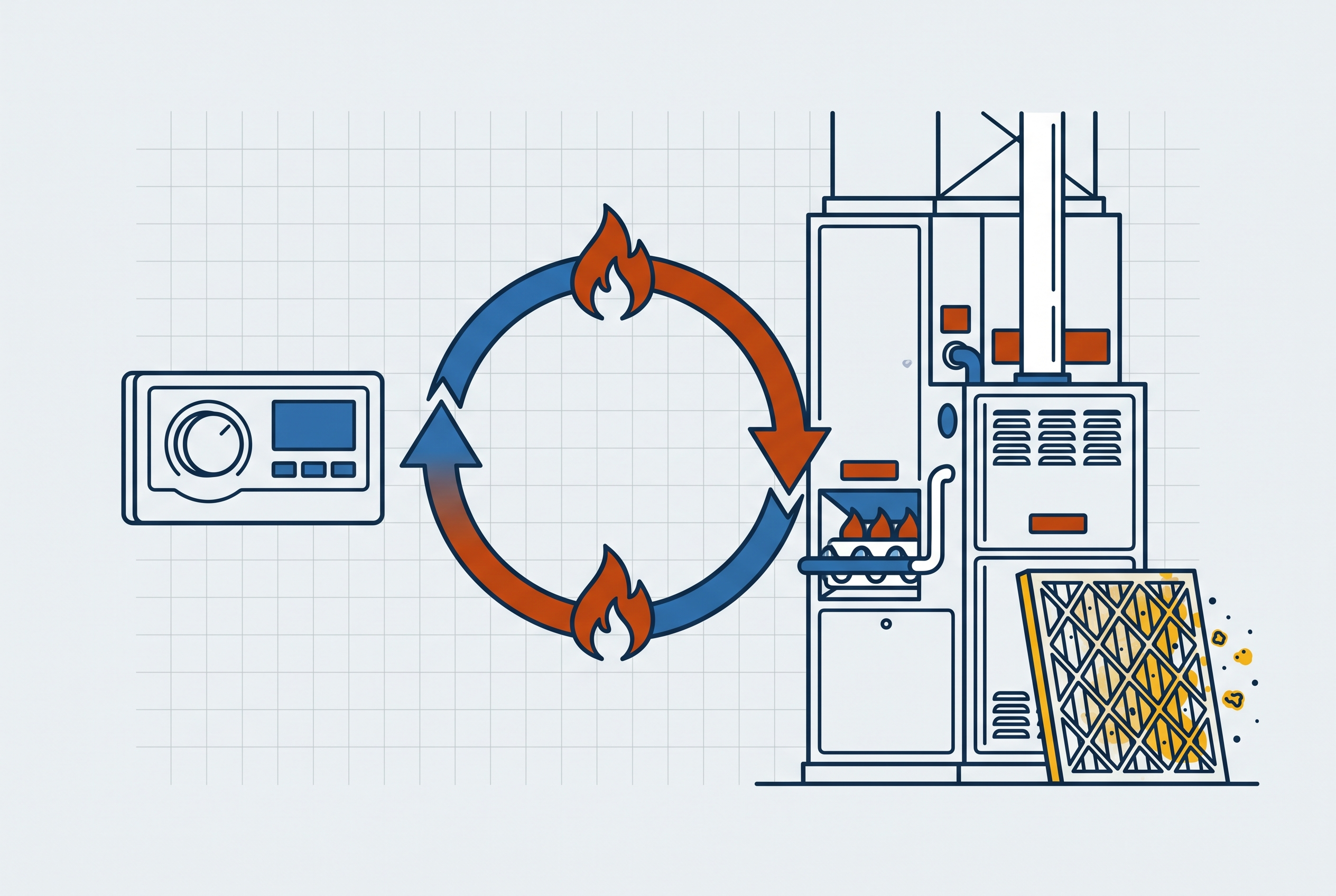
Short cycling means your furnace starts, runs for only a few minutes, shuts off and starts again, over and over, often without ever getting the house comfortable. The most common cause is a clogged air filter that makes the furnace overheat and trip its safety switch. Other causes include a dirty flame sensor, a poorly placed thermostat, blocked vents, and a furnace that’s too big for the house.
Short cycling wastes energy, wears out the igniter and other parts that work hardest at startup, and leaves rooms unevenly heated. Here’s how to narrow it down.

Cycle length varies with outdoor temperature, insulation and equipment, so there’s no single “correct” number. The tell-tale signs of short cycling are runs of just a few minutes, rooms that never quite warm up, and a furnace that seems to restart constantly.
1. A clogged air filter
A dirty filter starves the furnace of airflow. Heat builds up in the heat exchanger, the high-limit switch shuts the burners off to protect it, the furnace cools, and the cycle repeats. Check the filter first: ENERGY STAR recommends inspecting, cleaning or changing it monthly. If it’s gray and clogged, replace it and watch whether the cycling stops.
2. Blocked or closed vents
Closing too many supply registers, or blocking returns with furniture or rugs, has the same effect as a dirty filter: restricted airflow and overheating. Open the registers and clear the returns.
3. A dirty flame sensor
If the burners light and then shut off within a few seconds, the flame sensor probably can’t confirm the flame, usually because the rod is coated with residue. The furnace then retries. Cleaning the sensor is a common fix during routine service. See how a furnace works for where it sits in the sequence.
4. Thermostat problems
- Bad location. A thermostat near a supply register, in direct sun, or next to a lamp or kitchen warms up quickly and shuts the furnace off early.
- Weak batteries or loose wiring can cause erratic signals.
- Settings. Some thermostats let you adjust how many cycles per hour they allow; the wrong equipment setting can cause frequent cycling.
5. A blocked flue or intake
If the exhaust can’t leave freely, the pressure switch stops the furnace for safety. On high-efficiency furnaces, check that the outdoor plastic intake and exhaust pipes aren’t blocked by snow, leaves or nests. A blocked flue is also a carbon monoxide concern, so don’t ignore it.
6. Condensate drain problems (high-efficiency furnaces)
Condensing furnaces produce water that drains through a small tube and trap. If that line clogs or freezes, a float or pressure switch can shut the furnace off repeatedly. Look for water around the furnace or a full condensate trap.
7. A furnace that’s too big
An oversized furnace heats the air near the thermostat so fast that it shuts off before the rest of the house warms up. If short cycling has been there since the furnace was installed and none of the above fixes it, the unit may simply be too large for the home. A contractor can check this with a proper heat-load calculation.
What you can check yourself vs. when to call a pro
| Safe for most homeowners | Call an HVAC technician |
|---|---|
| Replace the air filter | Burners shut off seconds after lighting |
| Open registers and clear returns | Error codes pointing to the pressure or limit switch |
| Replace thermostat batteries | A blocked or damaged flue |
| Clear snow or debris from outdoor vent pipes | Cycling that continues after the simple fixes |
| Read the error code on the furnace door | Any smell of gas or a carbon monoxide alarm |
Safety first. Turn off power to the furnace before opening any panel. If you smell gas or a carbon monoxide alarm sounds, leave the house and call 911 or your gas utility from outside.
Frequently asked questions
Is short cycling dangerous?
Usually it’s a wear and efficiency problem, not an immediate danger. But overheating and blocked venting are safety issues, so a furnace that keeps tripping its limit or pressure switch should be inspected.
Can a new filter really fix it?
Often, yes. Restricted airflow is the most common cause, and a clean filter is the cheapest thing to try first.
Why does my furnace short cycle only on very cold days?
On high-efficiency furnaces, a partly frozen condensate line or snow around the outdoor vent pipes can cause trouble only in deep cold. Check the outdoor pipes first.
Sources
- ENERGY STAR, Maintenance Checklist