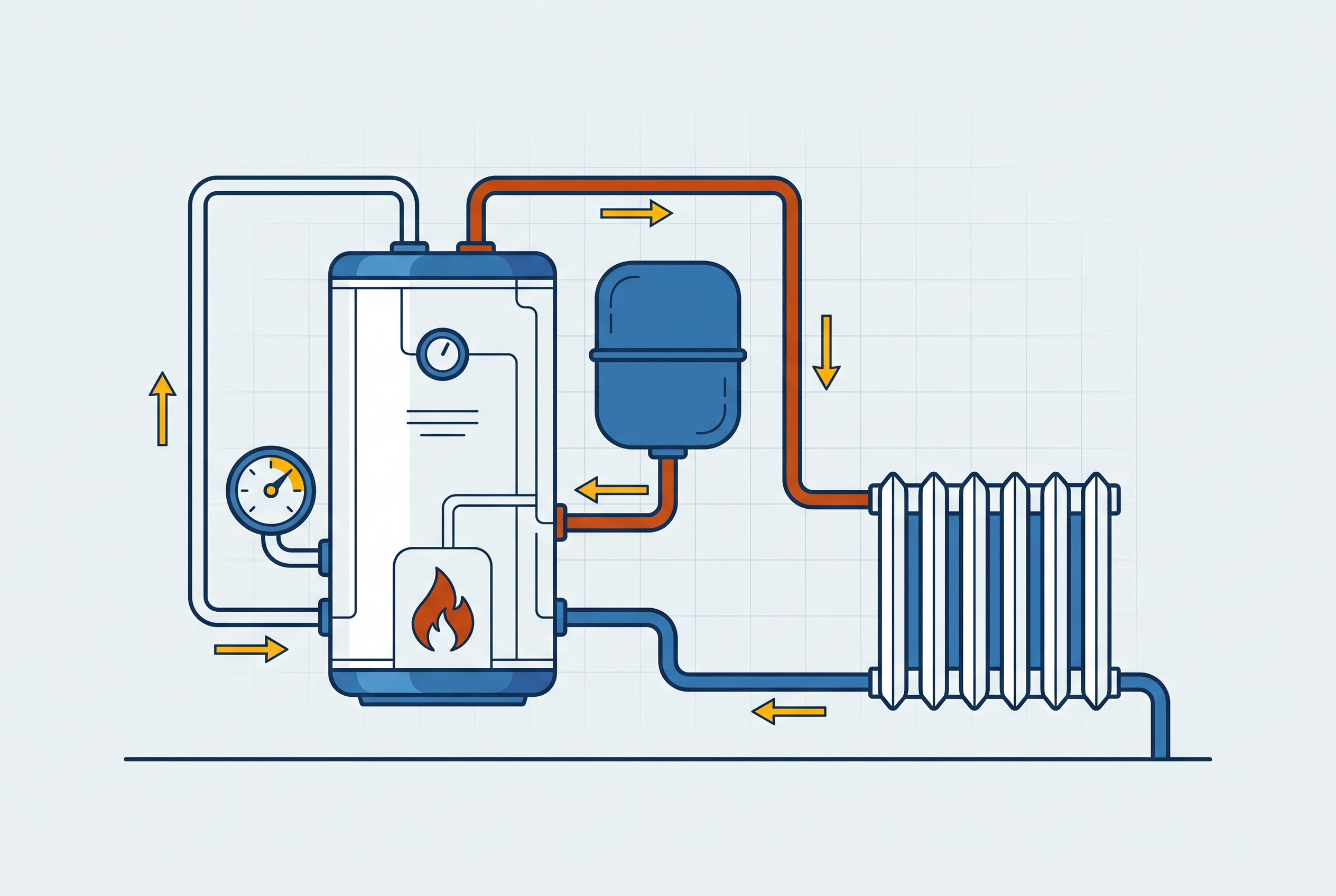
On a hot-water (hydronic) boiler, the pressure gauge shows how full and pressurized the closed loop of water is. Low pressure usually means the system has lost water, through a leak or after air was bled from radiators, and needs topping up. High pressure usually points to a failed expansion tank or a fill valve letting in too much water. The right range is in your boiler’s manual. A relief valve that drips or discharges is a sign the pressure is getting too high.
This guide covers hot-water boilers that heat radiators, baseboards or radiant floors. Steam boilers work at much lower pressures and use different gauges and controls.

Why a boiler needs pressure at all
A hydronic system is a sealed loop of water. A modest pressure pushes water up to radiators on upper floors and keeps air from collecting in the pipes. A fill valve connected to your water supply tops the loop up, and a circulator pump moves the water around.
Water expands as it heats, so the pressure naturally rises when the boiler is running. The expansion tank, which has an air cushion on one side of a rubber diaphragm, absorbs that extra volume so the pressure only rises a little. If the pressure ever climbs too high, the relief valve opens to release water and protect the boiler.
What’s a normal reading?
It depends on your home’s height and the boiler. Your manual, or a label from the installer, gives the target cold pressure and the normal range when hot. Many gauges also have a second needle or marked zone showing the set point. The relief valve’s tag shows the pressure at which it opens; the normal operating pressure should stay comfortably below that. A small rise between cold and hot is normal. A big jump is not.
If the pressure is too low
- You recently bled the radiators. Letting air out also lets a little water out, so pressure drops. Topping up fixes it.
- A leak. Look for damp spots or stains at radiator valves, pipe joints, the boiler itself, and the relief valve’s discharge pipe. Leaks in floors and walls may only show as stains.
- A fill valve that’s closed or clogged, so the system can’t top itself up.
Low pressure can cause cold radiators on upper floors, gurgling in the pipes, and on many modern boilers a lockout or error code. If you have to top up repeatedly, there’s a leak that needs finding.
If the pressure is too high
- A waterlogged or failed expansion tank. If the air cushion is lost, the tank can’t absorb expansion, so pressure spikes every time the boiler heats. A technician can check and recharge or replace it.
- A fill valve letting by. If the automatic fill valve doesn’t close fully, it keeps adding water until the relief valve opens.
- Overfilling. Topping up too far when cold leaves no room for expansion.
- A coil leak (on boilers that also heat domestic water). A failed internal coil can let higher-pressure tap water into the heating loop.
A relief valve dripping or spraying water is the clearest sign of high pressure. Never plug or cap it; it’s a critical safety device.
What you can check yourself vs. when to call a pro
| Safe for most homeowners | Call a heating technician |
|---|---|
| Read the gauge cold and hot and compare with the manual | Pressure that keeps dropping (a leak) |
| Look for drips at valves, joints and the relief pipe | A relief valve that drips or discharges |
| Top up through the fill valve as the manual describes | Pressure that spikes when the boiler heats |
| Note any error code on the boiler display | Expansion tank or fill valve replacement |
Safety first. Water from a relief valve or drain can be scalding. Never plug a relief valve or try to adjust it. Gas and oil boilers produce carbon monoxide: the CPSC advises installing CO alarms on every level of the home and outside sleeping areas. If an alarm sounds, get everyone into fresh air and call 911.
Frequently asked questions
Is it normal for boiler pressure to go up when the heat is on?
Yes, a little. Water expands as it heats. A large rise, or one that pushes toward the relief valve rating, points to an expansion tank problem.
How often should I have to top up the pressure?
Rarely. Occasional top-ups after bleeding radiators are normal. Needing to add water often means the system is losing it somewhere.
Does a boiler need yearly service?
ENERGY STAR recommends an annual pre-season check of heating systems, including burner combustion, gas connections and controls. For a boiler, that’s also when the expansion tank and relief valve get checked. For comparison, see how a furnace works.
Sources
- ENERGY STAR, Maintenance Checklist
- U.S. Consumer Product Safety Commission, Carbon Monoxide