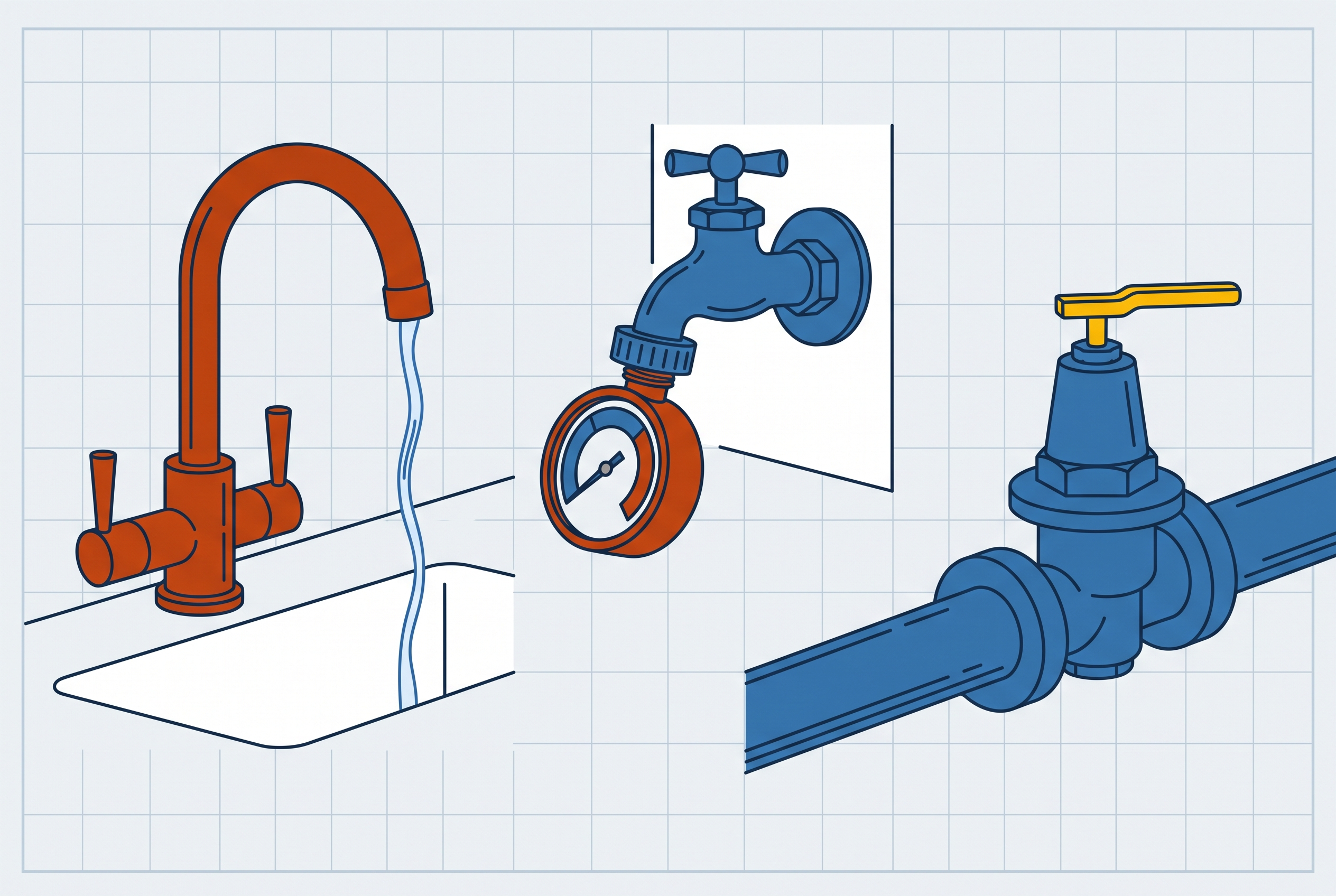
If water pressure is weak at every faucet in the house, the cause is somewhere between the street (or your well) and the first branch in your plumbing. The usual suspects are a main shutoff valve that isn’t fully open, a pressure reducing valve (PRV) that’s set low or failing, a leak, old pipes narrowed by corrosion, or a problem with the supply itself. If only one fixture is weak, the problem is local and usually much easier to fix.
A cheap pressure gauge that screws onto an outdoor hose bib gives you a real number to work with, and to share with a plumber or your water utility.

Start by narrowing it down
- Only one faucet or shower? Unscrew and clean the aerator or showerhead; mineral buildup is common. Check that the small shutoff valves under the sink are fully open.
- Only hot water? The problem is likely at the water heater: a partly closed valve on the heater, or sediment. See how a water heater works.
- Everywhere, hot and cold? Keep reading.
Whole-house causes
1. The main shutoff valve isn’t fully open
This is common after plumbing work. Find the main shutoff where the water line enters the house, often in a basement, crawlspace, garage or utility room. A gate valve (round handle) should be turned fully counterclockwise. A ball valve (lever) is fully open when the lever runs parallel to the pipe.
2. A pressure reducing valve that’s set low or failing
Many homes on city water have a pressure reducing valve, a bell-shaped brass valve near the main shutoff. It lowers high street pressure to a safer level for your plumbing. The U.S. Department of Energy’s Building America guidance notes that most plumbing codes require a PRV where supply pressure exceeds 80 psi, and recommends a maximum of 60 psi inside the home. If a PRV wears out or is set too low, pressure drops throughout the house. Adjusting or replacing one is a job for a plumber.
3. A leak
A significant leak in the supply line can sap pressure. Turn off every fixture and check your water meter: if the dial keeps moving, water is going somewhere. Also look for wet spots in the yard along the service line, or damp areas in the basement.
4. Old, corroded pipes
In older homes with galvanized steel pipes, rust and mineral buildup slowly narrow the inside of the pipe. Pressure may be fine with one tap open but drop sharply when two run at once. Replacing those pipes is the long-term fix.
5. The supply
Ask a neighbor. If they’re seeing the same thing, the cause may be a water main break, maintenance work or peak demand, and your water utility is the one to call. Homes on a private well depend on the well pump and pressure tank; a waterlogged pressure tank or a pressure switch set low can make pressure weak or surge up and down.
How to test your water pressure
- Buy an inexpensive pressure gauge with a hose-thread fitting.
- Make sure no water is running inside the house, including the dishwasher, washer and irrigation.
- Screw the gauge onto an outdoor hose bib (ideally the one closest to where water enters) and open the bib fully.
- Read the static pressure. Test at different times of day if the problem comes and goes.
Pressure that’s too high is a problem too. It strains pipes, valves and appliances and wastes water; Fort Worth’s water utility, for example, estimates that lowering pressure from 80 to 60 psi could save a typical home about 12,800 gallons a year.
What you can check yourself vs. when to call a pro
| Safe for most homeowners | Call a plumber |
|---|---|
| Clean aerators and showerheads | Adjusting or replacing a pressure reducing valve |
| Open the main shutoff and fixture valves fully | A leak in the service line or walls |
| Test pressure with a hose-bib gauge | Replacing corroded galvanized pipes |
| Check the water meter for hidden leaks | Well pump, pressure tank or pressure switch problems |
| Ask neighbors and call the water utility | Pressure consistently above 80 psi |
Safety first. Turn old valves gently; a corroded valve can break and leak. On a well system, turn off power to the pump at the breaker before touching the pressure switch, which carries line voltage. If you lose pressure suddenly and see water pooling, shut off the main and call a plumber.
Frequently asked questions
Why did my water pressure drop suddenly?
A sudden drop for the whole house is often a utility issue (a main break or work in the street), a leak, or a failed PRV. Check with neighbors first.
Can a water softener or filter cause low pressure?
Yes. A clogged whole-house filter cartridge or a softener with a problem can restrict flow. Try the bypass valve: if pressure improves, the treatment equipment is the cause.
Do I have a pressure reducing valve?
Look near the main shutoff for a bell- or dome-shaped brass valve, often with an adjusting screw on top. Not every home has one; it depends on your local supply pressure and code.
Sources
- U.S. Department of Energy, Building America Solution Center, Service Water Pressure
- City of Fort Worth Water Department, High Plumbing Pressure