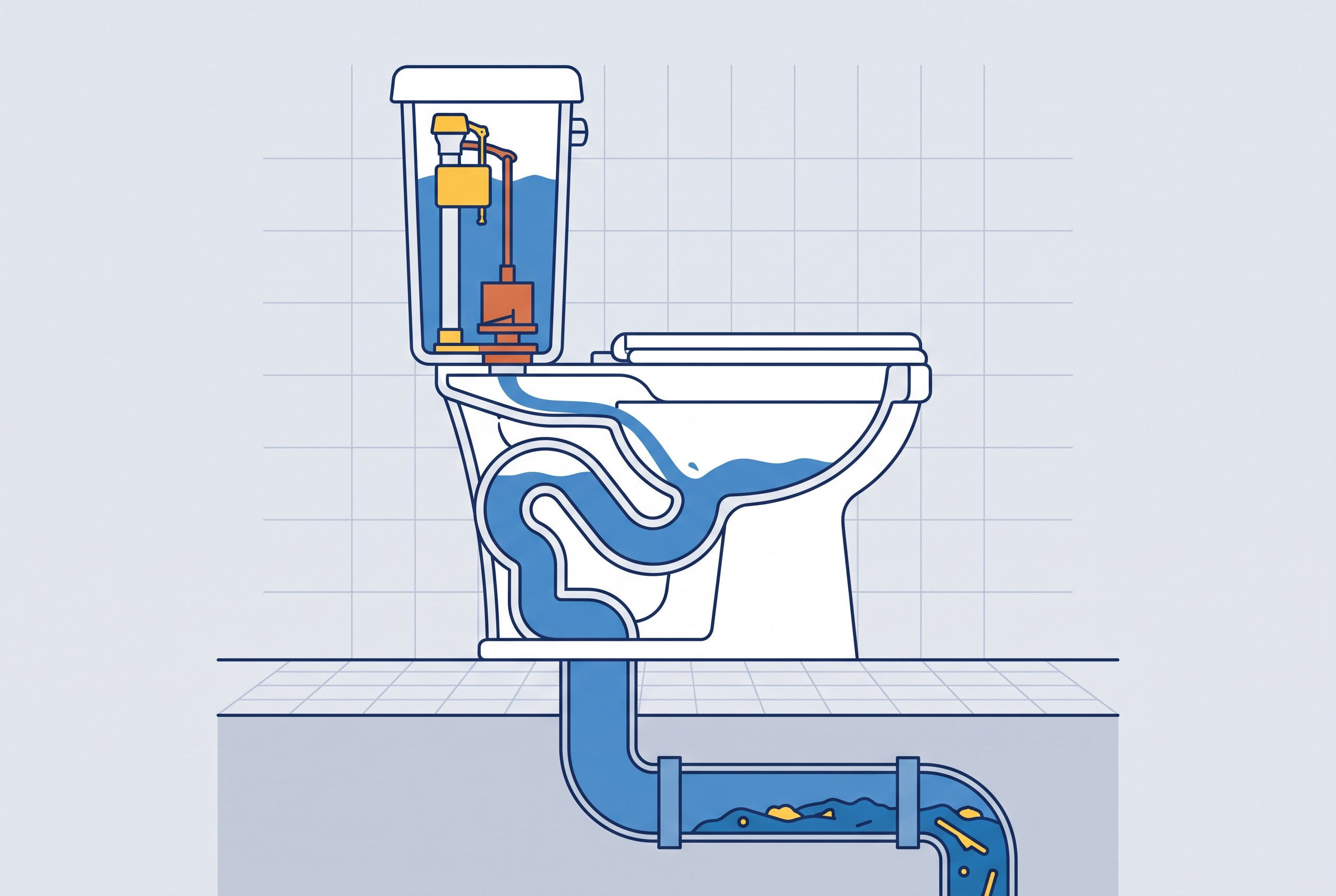
A standard toilet flushes by siphon. When you push the handle, the tank dumps its water into the bowl all at once. That surge fills the S-shaped channel hidden inside the porcelain, called the trapway, and once it’s full, gravity pulling water down the drain side sucks the bowl empty. When air reaches the trapway, the siphon breaks with that familiar gurgle, and the tank refills the bowl to restore the water seal.
No pumps or motors are involved in a standard gravity toilet: just stored water, gravity and a cleverly shaped bowl.

The parts
- Tank. Stores the water for the next flush. Inside are the fill valve, float, flapper and overflow tube; our guide on why a toilet keeps running has a labeled diagram of the tank.
- Flush valve and flapper. A large opening at the bottom of the tank, sealed by a rubber flapper until you flush.
- Rim holes. Small holes under the bowl’s rim spray water down the sides to rinse it.
- Siphon jet. On many toilets, a hole near the bottom of the bowl shoots water straight into the trapway to start the siphon faster.
- Trapway. The curved channel cast into the base. Its shape holds standing water in the bowl and makes the siphon possible.
- Water seal. The water that stays in the bowl blocks sewer gas from coming up into the room.
- Wax ring and flange. A ring of wax (or a foam or rubber gasket) seals the toilet’s outlet to the flange on the drainpipe in the floor.
A flush, step by step
- The handle lifts the flapper with a chain.
- Water rushes out of the tank, through the rim holes and siphon jet, into the bowl.
- The water level in the bowl rises fast enough to fill the trapway completely.
- The siphon starts: water falling down the drain side pulls the bowl’s contents after it.
- When the bowl is nearly empty, air enters the trapway and the siphon breaks with a gurgle.
- The flapper drops and seals the tank. The fill valve refills the tank, and a small refill tube tops up the bowl to restore the water seal.
How much water a flush uses
According to the U.S. Environmental Protection Agency, toilets account for nearly 30% of an average home’s indoor water use. The federal maximum for new toilets is 1.6 gallons per flush, and toilets with the EPA’s WaterSense label use 1.28 gallons or less, about 20% less. The EPA estimates that replacing older toilets with WaterSense models can save nearly 13,000 gallons per home per year.
Other types of toilets
- Dual-flush toilets have two buttons: a smaller flush for liquid waste and a full flush for solids.
- Pressure-assisted toilets have a sealed vessel inside the tank that uses the house’s water pressure to compress air, giving a stronger, louder flush.
- Washdown toilets, common outside North America, rely more on the force of the water than on a siphon.
Common problems and what they mean
| Symptom | Likely cause |
|---|---|
| Weak flush that doesn’t clear the bowl | Low tank water level, clogged rim holes or siphon jet, or a partial clog |
| Tank keeps refilling | A leaking flapper or a water level set too high |
| Water on the floor around the base | A failed wax ring, or a loose toilet |
| Sewer smell | A dried-out water seal in a rarely used toilet, or a failed wax ring |
| Bowl gurgles when other drains run | A venting problem or a clog further down the line |
What you can do yourself vs. when to call a pro
| Safe for most homeowners | Call a plumber |
|---|---|
| Adjust the tank water level and chain | Water leaking from under the toilet |
| Replace a flapper or fill valve | Recurring clogs or several slow drains at once |
| Clear a simple clog with a flange plunger | Cracked porcelain |
| Flush a rarely used toilet to refill its seal | Removing and resetting the toilet |
Good to know. Before working inside the tank, close the shutoff valve behind the toilet and flush to drain it. Porcelain is heavy and cracks easily, so set the lid on a towel. Avoid mixing drain cleaners with other chemicals, and don’t use chemical drain cleaners in a toilet before plunging, since splashback can burn skin and eyes.
Frequently asked questions
Why does my toilet gurgle at the end of a flush?
That’s the siphon breaking as air enters the trapway. It’s normal. Gurgling when you’re not flushing, or when other fixtures drain, is a different story.
Can I flush with a bucket during a water outage?
Yes. Pouring about a gallon or more of water quickly into the bowl can start the siphon on most gravity toilets, as long as the drain line is working.
Why do newer toilets sometimes clog more?
Some early low-flow designs struggled. Modern designs have improved a lot, and WaterSense-labeled models must also meet a flush performance test.
Sources
- U.S. EPA WaterSense, Residential Toilets
- U.S. EPA WaterSense, Fix a Leak Week