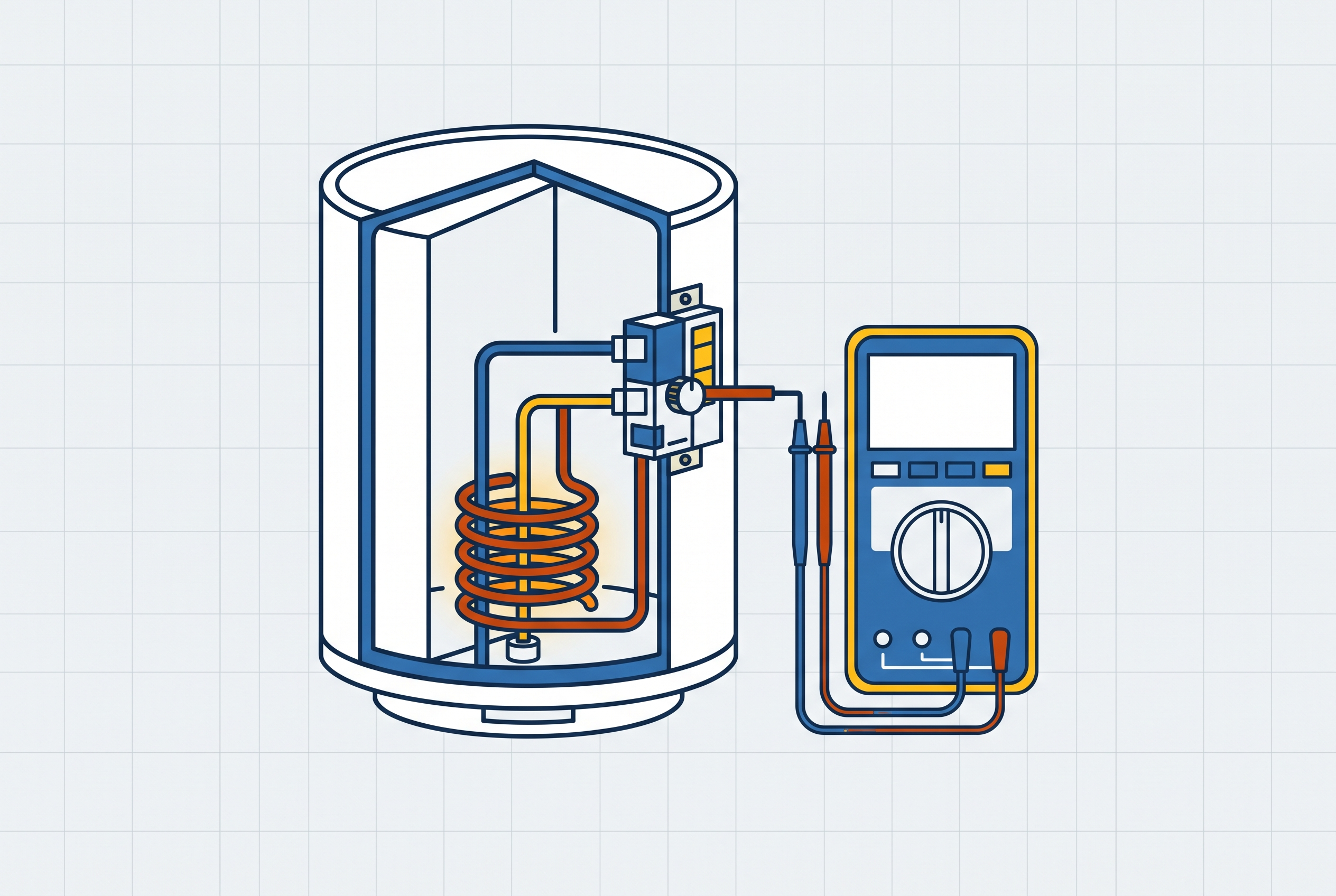
A water heater element is the electric heating coil that sits inside the tank and warms the water. Most electric tank heaters have two, an upper and a lower. When one fails you typically get lukewarm water, hot water that runs out fast, or no hot water at all. You can test an element with a multimeter: with the power off, a good element reads between 5 and 25 ohms, and a reading outside that range means it should be replaced.
Testing and swapping an element is a job many handy homeowners do, but it involves high-voltage wiring and a full drain of the tank, so the order of the steps matters.

What a water heater element does
Electric current passes through the element, which resists the flow and turns it into heat. The element is submerged, so the water around it absorbs that heat directly. A thermostat sits against the tank next to each element and switches it on and off to hold the temperature you set. If you are new to how the rest of the tank works, our guide to how a water heater works covers the parts.
A.O. Smith’s maintenance guide notes that the lower thermostat does most of the work, which is why it is the thermostat most likely to wear out. The elements and thermostats are separate parts, and a heater with no hot water can have a bad one of either.
Signs a water heater element has failed
Common signs include water that never gets fully hot, hot water that runs out much sooner than it used to, or water that is cold all the time. Before you blame the element, rule out the simple causes:
- A tripped breaker. A.O. Smith calls a tripped circuit breaker a very common reason for an electric water heater not working. Reset it once. If it trips again, stop and look for a short, a loose wire or a grounded element.
- A tripped high-limit button. Most electric heaters have a red reset button on the upper thermostat. If it has tripped, the water heater overheated, and repeated tripping points to a bad thermostat or a shorted element.
- The thermostat setting. A setting that was changed or knocked can look like a failed element.
If you have no hot water at all, our step-by-step no hot water check walks through both electric and gas models.
How to test a water heater element
You need a multimeter that reads resistance (ohms) and a non-contact voltage tester or the meter’s voltage setting to confirm the power is really off.
- Turn off the water heater’s breaker at the panel. Per A.O. Smith, confirm with a meter or tester that the circuit is dead, because working on an energized circuit can cause severe injury or death.
- Remove the access panel, insulation and plastic protector over the element and thermostat.
- Disconnect the wires from the element’s two screw terminals so the reading is not affected by the rest of the circuit.
- Set the meter to its lowest resistance setting and touch one probe to each terminal. A good element reads between 5 and 25 ohms; A.O. Smith gives 12.5 ohms as typical. A reading outside that range means replace it.
- Check for a ground fault: set the meter to its highest resistance setting and touch one probe to a terminal and the other to the element’s metal mounting flange. A reading of “OL” means the element is not grounded. A low reading means it is shorted, and the element should be replaced.
If both elements test good but you still have no hot water, the thermostat is the next suspect. A.O. Smith’s guide says to replace the upper thermostat if the upper element tests good and there is still no hot water.
How to replace a water heater element
These steps follow A.O. Smith’s published instructions for replacing a lower element. Always check your own heater’s manual, since details vary by model.
- Cut the power at the breaker and verify it is off.
- Cool and drain the tank. Run a hot tap until the water runs cool to reduce the risk of scalding, close the cold supply valve, attach a hose to the drain valve and open a hot faucet to speed up draining. Let the tank empty completely.
- Remove the old element with an element wrench or a 1½-inch socket.
- Match the new element to the voltage and wattage printed on the water heater’s data plate. Clean the tank threads and seat the new gasket, using a drop of dish soap to help it slide on without tearing.
- Tighten the element, reconnect the wires firmly and make sure the thermostat sits tight against the tank.
- Refill the tank before restoring power. Close the drain, reopen the cold supply and let a hot faucet run at full stream for three minutes to purge the air. A.O. Smith warns not to turn the power back on until the tank is completely full of water. Check for leaks at the element.
- Replace the protector, insulation and cover, then restore power. A.O. Smith says to allow about two hours for the tank to heat.
Why elements burn out early
The main cause A.O. Smith names is dry firing: powering an element that is not fully underwater. It burns out within moments, which is why the refill step above is not optional. Mineral buildup is another factor. The Pacific Northwest National Laboratory notes that sediment in a tank can leave mineral deposits on the heating element, reducing how well it transfers heat to the water. Keeping an eye on the tank’s overall condition, including the anode rod, and knowing how long water heaters last helps you decide whether a new element is worth it on an older tank.
What you can do yourself vs. when to call a pro
| Safe for most homeowners | Call a licensed pro |
|---|---|
| Check the breaker and the red reset button | A breaker that trips again right after resetting |
| Test an element with a meter once the power is verified off | Burn marks, melted wires or a burning smell at the element or thermostat |
| Replace an element with the exact voltage and wattage | Leaks around the tank, rust or a corroded tank |
| Drain the tank through the drain valve | Both elements test good but there is still no hot water |
| Refill fully before restoring power | Any doubt about working near high-voltage wiring |
Safety first. High-voltage electricity can kill, and water heater parts can stay live even when the unit is not actively heating. Turn the breaker off and prove the circuit is dead with a tester before you touch anything. Never switch the power on while the tank is empty or partly empty. If you are not comfortable working with electrical wiring, hire a licensed electrician or plumber.
Frequently asked questions
Do I need to drain the tank to replace an element?
A.O. Smith’s replacement instructions include draining the tank before the old element comes out. Follow your own heater’s manual.
Should I replace both elements at once?
Not necessarily. Test each one and replace only the one that fails. If the tank is already open and you are draining it, some people swap both while the tank is empty, but it is not required.
Why did my new element burn out right away?
The most likely reason is dry firing, meaning power was restored before the tank was completely full. Make sure the tank is full and the air is purged before you switch the breaker back on. A wrong voltage or wattage rating is another possible cause.
Sources
- A. O. Smith, Replace the Lower Heating Element
- A. O. Smith, Maintenance & Troubleshooting Guide
- A. O. Smith, Is Your Hot Water Not Getting Hot? Common Causes
- Pacific Northwest National Laboratory, Flush Water Heater Tank (DIY guide)