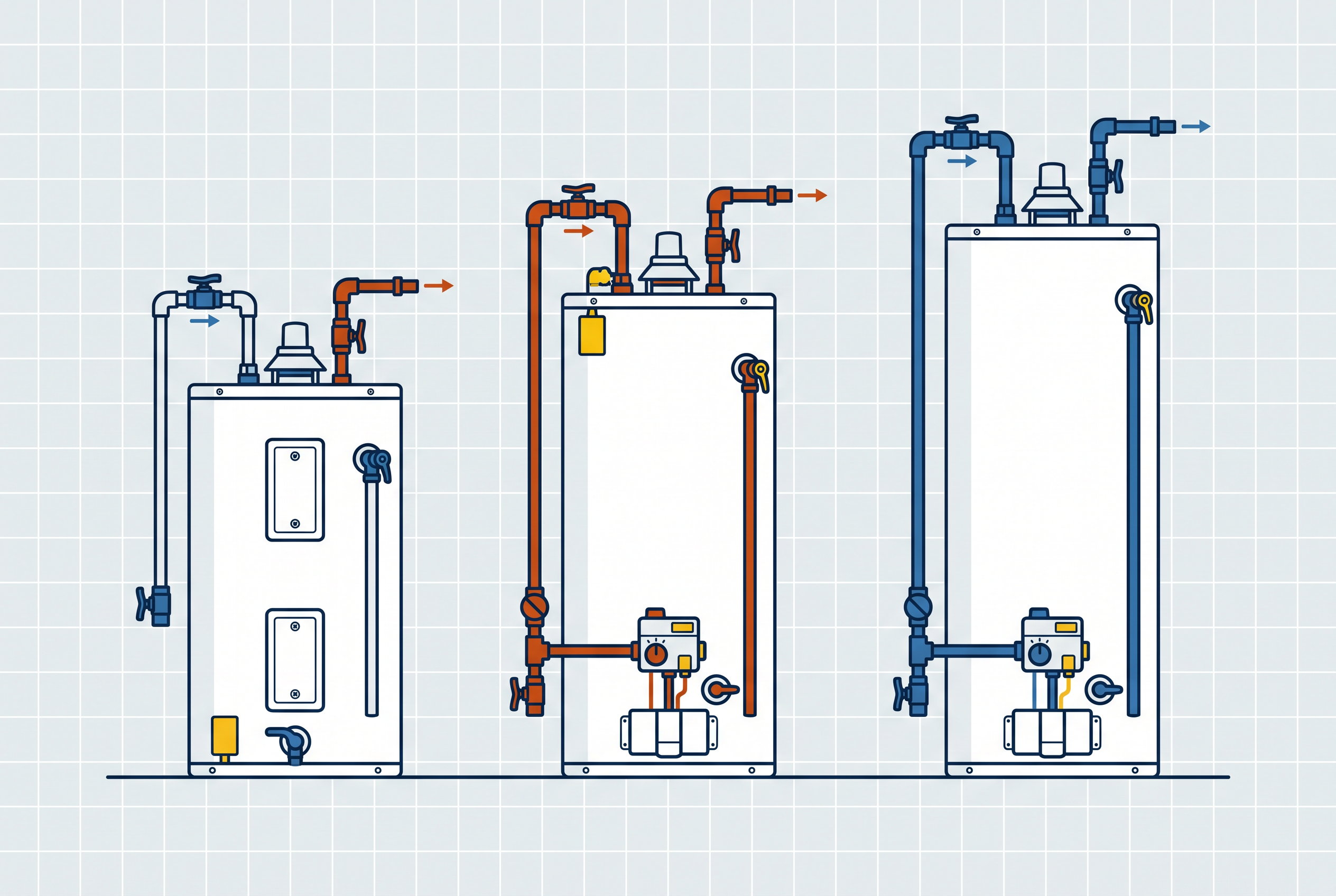
Most households are well served by a 40- to 50-gallon tank, whether that is a 40 gallon gas water heater or an electric model, and 40 gallons is the most common size. But gallons are only part of the picture. The better measure is the first hour rating: how many gallons of hot water the heater can deliver in one busy hour. Match that number to your household’s peak hour and you’ll get the right size, whether the label says 30, 40, 50 or 80 gallons.
Here is how the common sizes line up with household size, and why two tanks with the same capacity can perform differently.

Tank size versus first hour rating
A storage water heater keeps a reservoir of hot water ready. Its capacity in gallons tells you how big that reservoir is, but it doesn’t tell you how fast the tank can recover once you’ve emptied it. That is what the first hour rating covers. The U.S. Department of Energy defines it as the number of gallons of hot water the heater can supply per hour, and says it depends on tank capacity, the heat source, and the size of the burner or element.
In practice, this means two 40-gallon models can have different first hour ratings if one is gas and the other electric, or if their burner or element sizes differ. The rating is listed on the EnergyGuide label. Heat pump water heaters don’t get that label, so check the maker’s literature for those.
How to estimate your peak hour
Think about the busiest hour of your day, usually a weekday morning. Add up the hot water you use in that single hour: showers, a shave, hand dishwashing, a load of laundry on a warm setting. The Department of Energy’s worksheet example adds up to 66 gallons for three showers, a shave and hand dishwashing, and its advice is to pick a heater whose first hour rating at least matches your peak hour demand. If your total comes to about 66 gallons, look for a first hour rating of 66 gallons or more.
If you’re replacing a heater and the old one has served you well, the old rating is a good starting point. If you ran out of hot water regularly, go up a size or look for a higher first hour rating at the same tank size.
Common sizes and who they fit
Sources don’t agree exactly on the tank-to-household match, which is another reason to rely on the first hour rating. Two commonly cited guides give these rules of thumb:
- Department of Energy: a small tank of 50 to 60 gallons is usually enough for one to three people, an 80-gallon tank works well for three to four people, and a large tank suits four to six people.
- Home Depot’s buying guide: an average household of two to three people is fine with a 40- to 50-gallon tank, with roughly 10 more gallons for each additional person. It lists tank models from 20 to 80 gallons.
Bob Vila’s cost guide similarly reports that storage tanks typically hold 30 to 80 gallons and that 40 gallons is the most common size. Home Depot’s guide puts a household of two or fewer people at roughly 23 to 36 gallons, which is where a 30-gallon tank fits. At the other end, the Department of Energy describes an 80-gallon tank as a fit for three to four people and larger tanks for four to six.
40 gallon gas water heater vs. 50 gallon
If you’re torn between a 40 and a 50, the practical difference is a bigger buffer for the busiest hour. A 50-gallon tank gives you more hot water before the heater has to catch up, which helps if you have teenagers, a soaking tub, or guests. A 40-gallon tank can be the better choice if you have limited space or a small household, since it keeps less water hot around the clock.
Before you decide, compare the first hour ratings on the labels of the models you’re considering rather than the gallon count alone. Because the rating depends on the heat source and burner size as well as the tank, the larger tank isn’t automatically the stronger performer.
If you are considering tankless
Tankless heaters don’t have a tank size. They are rated by the temperature rise they can deliver at a given flow rate. To size one, the Department of Energy says to add up the flow rates of the fixtures you expect to run at the same time, and to look for a unit that delivers at least 3.25 gallons per minute. Its example assumes incoming water at 50°F and a target of 120°F, which is a 70°F rise. If you don’t know a fixture’s flow rate, time how long it takes to fill a bucket or pan for one minute. Our guide to tank vs. tankless water heaters covers the other trade-offs.
Before you buy: check the fit
The new tank has to fit the space, the existing venting and the existing supply. A gas water heater needs a vent that carries exhaust outside, and an electric one needs a suitable electrical supply. Switching from one fuel to another can mean adding a breaker, running a gas line or venting the unit outdoors, according to the Department of Energy. For a refresher on how the parts fit together, see how a water heater works.
What you can do yourself vs. when to call a pro
| Safe for most homeowners | Call a licensed plumber or electrician |
|---|---|
| Read the rating plate and EnergyGuide label for the first hour rating | Replacing a gas water heater, including the gas connection and venting |
| Estimate your peak hour hot water use | Changing from gas to electric, or from tank to tankless |
| Compare first hour ratings across models before buying | Adding or upgrading an electrical circuit or breaker |
| Measure the space and note the current tank’s height and width | Any work on a flue, vent pipe or gas line |
| Time how long your fixtures take to fill a bucket for tankless sizing | Sizing for a large household or several bathrooms |
Safety first. Gas water heaters burn fuel and must vent exhaust outside. A damaged or blocked vent can release carbon monoxide, which has no color or smell. Have a licensed pro handle gas lines, venting and electrical work. The Consumer Product Safety Commission recommends installing CO alarms on every level of the home and outside sleeping areas. If you smell gas, leave the house and call your gas utility or emergency services from outside.
Frequently asked questions
What size water heater do I need for a family of four?
The Department of Energy points to an 80-gallon tank for three to four people, while the Home Depot guide’s rule of 40 to 50 gallons for two to three people plus about 10 per extra person works out to roughly 50 to 60 gallons for four. The gap shows why you should match the first hour rating to your own peak hour rather than relying on a single rule of thumb.
Is a bigger water heater always better?
No. A larger tank costs more to buy and keeps more water hot around the clock, which wastes energy if you rarely use that much. Choose the smallest tank whose first hour rating covers your busiest hour.
Is a 40 gallon gas water heater enough for two people?
For most two- or three-person homes, yes. Both the Department of Energy and the Home Depot guide describe tanks in the 40- to 60-gallon range as typical for smaller households. Check the first hour rating against your busiest hour.
Sources
- U.S. Department of Energy, Sizing a New Water Heater
- U.S. Department of Energy, Selecting a New Water Heater
- The Home Depot, Types of Water Heaters: Electric vs. Gas (buying guide)
- Bob Vila, Water Heater Replacement Cost (tank size range)
- U.S. Consumer Product Safety Commission, Carbon Monoxide Information Center