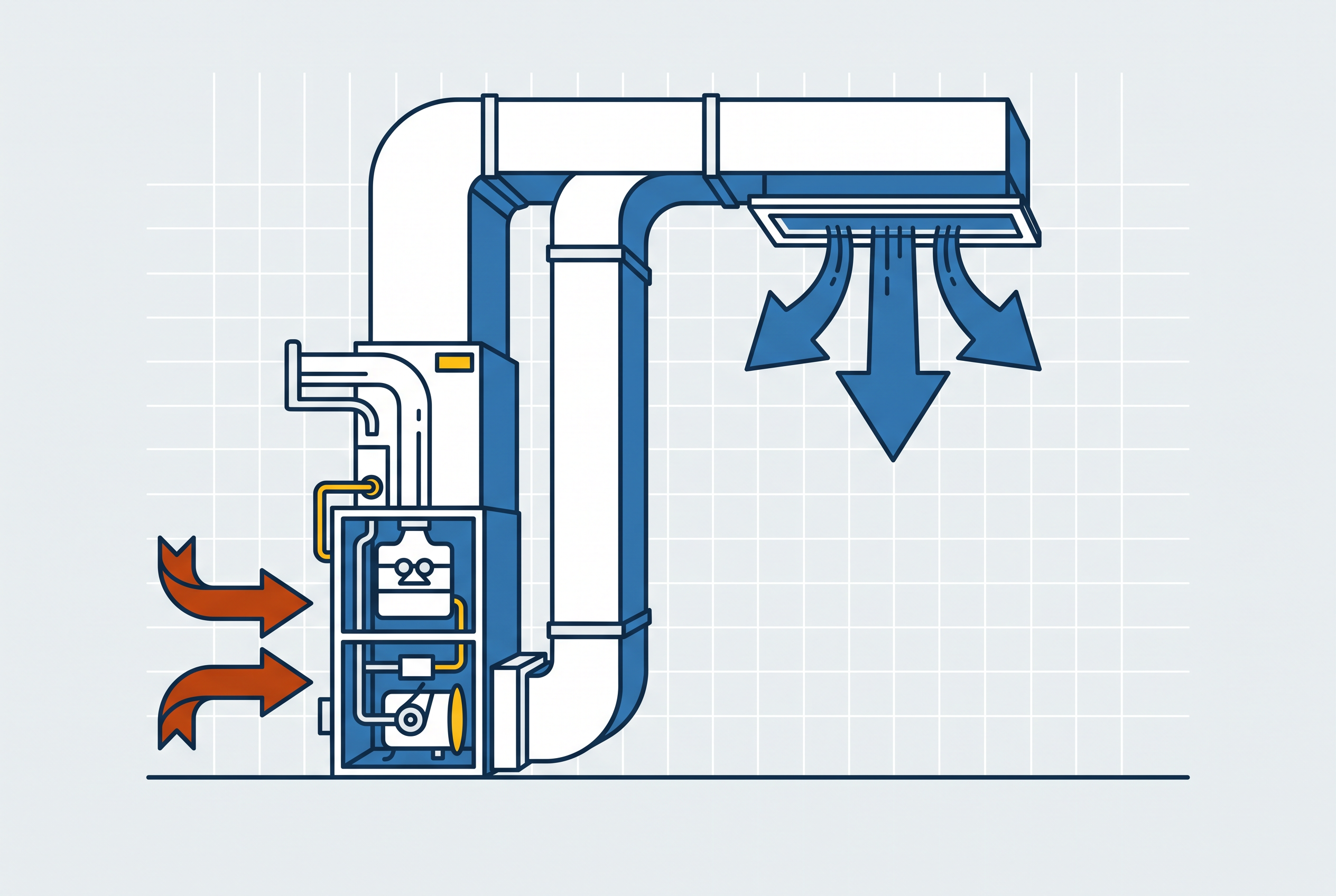
If your furnace is not blowing hot air, the most common cause is that the burners aren’t firing while the blower keeps running. That can be as simple as a fan set to ON instead of AUTO, or a dirty filter that overheated the furnace and tripped a safety switch. Check the thermostat settings and the filter first. If the air is still cool, the cause is likely the flame sensor, ignition or gas supply, and you’ll need a technician.
It also helps to know that a short stretch of cool air at startup is normal.

First, is it normal?
Carrier notes that the blower may wait roughly 30 to 60 seconds after ignition so the heat exchanger can warm up before it pushes air through the ducts. A brief burst of cool air right after the furnace starts is normal. If the air is still cool a few minutes later, keep reading.
Thermostat settings: fan on ON instead of AUTO
Carrier calls this the most common cause of cold air. With the fan set to ON, the blower runs continuously and circulates room-temperature air between heating cycles, so the vents feel cool whenever the burners are off. Setting the fan to AUTO means the blower only runs while the system is heating. While you’re at the thermostat, confirm the mode is Heat, the set temperature is above the room temperature, the batteries are fresh, and (on a programmable model) the schedule hasn’t been thrown off by a power outage or daylight saving time.
A dirty filter and the high-limit switch
Restricted airflow can make the furnace overheat. Trane explains that a dirty filter can cause the furnace to overheat and shut down as a safety precaution, and Carrier says a limit switch trip shuts off the burners while the blower keeps running. That produces exactly the symptom of a furnace that is not heating but is still blowing air. Replace the filter, then restart the furnace. Trane says to change filters every 30 to 90 days; Carrier says to check basic filters every one to three months, more often with pets or dust. Repeated overheating from a dirty filter can damage the limit switch itself. Our MERV rating guide helps you choose a filter that doesn’t choke airflow.
Blocked vents and leaky ducts
Closing too many supply vents or blocking return grilles with furniture or rugs raises system pressure and can also trigger the limit switch. Open the vents and clear the returns. Carrier adds that leaky ducts lose warm air into an attic or crawlspace and can pull in unconditioned air, which gives lukewarm air and higher bills. You can feel for leaks at accessible joints with the system running and seal visible ones with metallic foil tape or mastic; ducts hidden in walls need a professional.
Why the burners might not be firing
If the settings, filter and vents are fine, the burners themselves may not be lighting or staying lit. Trane and Carrier list these causes:
- Pilot light out on older gas furnaces that use a continuous pilot. Relight only by following the owner’s manual.
- A failed electronic igniter on newer furnaces. Igniters wear out from frequent cycling.
- A dirty flame sensor that can’t detect the flame, so the furnace shuts the burners off. Trane says the sensor exists so the gas valve only opens while flames are burning.
- Dirty burners that block fuel flow.
- No fuel: a closed gas valve, or an empty propane or oil tank.
- A clogged condensate drain on a high-efficiency furnace, which triggers a safety measure that stops the burners from igniting.
- A control board failure.
Most of these need an HVAC professional. If the furnace runs briefly and then stops, also read furnace short cycling, and if it never starts, see furnace not turning on.
Is it a furnace or a heat pump?
This guide covers gas furnaces. If you have a heat pump, the causes are different, so see why a heat pump blows cold air instead. For how a gas furnace makes heat in the first place, read how a furnace works.
What you can do yourself vs. when to call a pro
| Safe for most homeowners | Call an HVAC technician |
|---|---|
| Set the mode to Heat and the fan to AUTO | Pilot assembly, igniter or flame sensor service |
| Replace the thermostat batteries and check the schedule | A limit switch that needs testing or replacement |
| Replace a dirty filter and restart the furnace | Gas valve, control board or burner problems |
| Open supply vents and clear return grilles | A clogged condensate drain or pump |
| Seal visible duct joints with foil tape or mastic | Hidden or extensively leaking ductwork |
Safety first. Don’t attempt DIY fixes on gas components. If you smell gas or notice soot around the furnace, turn the system off and contact a professional; if you smell gas, leave the house and call your gas utility or emergency services from outside. A carbon monoxide alarm that sounds means getting outside to fresh air and calling 911. Don’t remove the furnace cabinet door unless the owner’s manual allows it.
Frequently asked questions
Why is my furnace blowing cold air instead of hot?
The usual causes are a fan set to ON rather than AUTO, a dirty filter that triggered the high-limit switch, or burners that aren’t lighting because of the igniter, flame sensor or fuel supply. Check the thermostat and filter first.
Why does my furnace blow cold air for a few minutes at startup?
The blower may wait about 30 to 60 seconds after ignition so the heat exchanger can warm up. A short burst of cool air at the start of a cycle is normal.
How often should I change my furnace filter?
Trane suggests every 30 to 90 days and Carrier says to check basic filters every one to three months. Change it more often if you have pets or a lot of dust.
Sources
- Carrier, Why Is My Furnace Blowing Cold Air?
- Trane, Furnace Not Blowing Hot Air? Get Help Now
- Trane, Furnace Main Burner Shuts Off After Ignition: 4 Reasons Why
- Carrier, Heater Not Working? Try Our Furnace Troubleshooting Guide
- U.S. Consumer Product Safety Commission, Carbon Monoxide Information Center